

SALT/SEL:
Sodium is a chemical element; it has symbol Na+ (from Neo-Latin: Natrium) and atomic number 11. It is a soft, silvery-white, highly reactive explosive metal. It does not occur freely in nature.
….. Chlorine, a chemical element; it has the symbol Cl- (based, I imagine on the Greek word for its colour, khloros!) Its atomic number 17 and is a very deadly aggressive yellowy green gas!
Le sodium est un élément chimique ; il a pour symbole Na+ (de néo-latin : Natrium) et numéro atomique 11. C’est un métal explosif doux, blanc argenté et très réactif. Il ne se produit pas librement dans la nature.
….. Le chlore est un élément chimique ; il porte le symbole Cl- (basé, j’imagine, sur le mot grec pour sa couleur, khloros !) Son numéro atomique est 17 et c’est un gaz vert jaunâtre agressif très mortel !
Together they become NaCl, table salt, essential to us as human beings.
Think of the words salus (latin) or salut or salute.
We cannot live without it. It is one of our five basic tastes and is crucial to the function of other senses.
In fact, all life depends on its chemical properties to survive.
Ensemble, ils deviennent NaCl, le sel de table, essentiel pour nous en tant qu’êtres humains.
Pensez aux mots salus (latin) ou salut ou salute.
Nous ne pouvons pas vivre sans cela. C’est l’un de nos cinq goûts de base et il est crucial pour le fonctionnement des autres sens.
En fait, toute vie dépend de ses propriétés chimiques pour survivre.
It has been used by humans for thousands of years, from food preservation to seasoning. Salt's ability to preserve food was a founding contributor to the development of civilization. It helped eliminate dependence on seasonal availability of food and made it possible to transport food over large distances.
This dependence resulted in the building of empires, defined economies and opening of trade routes and decided the outcomes of many bitter wars.
It was never more valuable than gold but in a certain way it had an even stronger impact on history.
Have you ever wondered how Venice built such a huge empire? SALT!
How India got its independence from the British? SALT!
Why America wanted their independence from the British? SALT!
Is salt really bad for your body?
Salt has played a critical role in ancestral food preparation for thousands of years. Yet, in the last few decades, salt has been made into somewhat of a villain as it’s been associated with hypertension and heart disease.
The notion that a low salt diet is better for us began about 200 years ago and was founded on erroneous science. Doctors knew then that our bodies relied on salt to maintain blood pressure balance. They believed that consuming too much salt contributed to high blood pressure and heart disease. The result was huge (unsuccessful) government campaigns to get people to eat less salt.
However, research is finding that this fundamental theory isn’t as clear cut as we once thought. A meta-analysis of over 6,250 patients found there was no actual link between salt intake, high blood pressure, and risk of heart disease. Like many of our dietary recommendations, our beliefs surrounding salt need to be re-examined.
Symptoms of salt deficiency and salt restriction
If you don’t get enough salt, it can cause problems with your body and health. Here are a few signs of salt deficiency from salt restriction: Reduced hydration, especially in athletes, muscle cramps, higher risk of heart attack, headaches, weakness, cognitive decline in elderly and irritability.
Why does your body need salt?
We used to think that our body’s weren’t particularly good at regulating salt levels. For example, it was believed that if you ate more salt, you’d become thirsty and drink more water, which would cause you to dilute the sodium levels in your body.
However, studies are finding that salt has many benefits in the body, including increasing body water conservation and making you less thirsty – probably the opposite of what you might have guessed. This means that your body can prioritize its salt levels, which has been shown help manage metabolism in a positive way.
Our bodies use sodium ions for everything from communication between neurones to managing blood pressure…..but our bodies cannot just manufacture sodium (we would need to be able to generate heat of stellar proportions) we need to get at least some of it from our diet! A lack of salt in the blood is called HYPONATREMIA
A large percentage of salt is incorporated into the medicines of today!
Sea salt is an excellent source of electrolytes, which has been shown to prevent muscle cramping during exercise. Sea salt contains sodium, magnesium, potassium, and calcium, all of which you need for optimal health. These minerals must come from your diet because your body can't create them.
Humans are hardwired to like salt because we need it to survive!
We developed a taste and a craving for it to ensure we get enough! The "salt" taste buds are on either side of the front of the tongue which signals directly to the brain … salt makes taste sensations sweeter because it reduces our reception of bitter flavours; salt is actually better at reducing bitterness sensations than sugar! Most of the bitterness blocking happens in the taste buds where it is thought that sodium ions might interfere with the binding between the bitter compounds and their taste cell receptors.
Salt also reduces other unpleasant tastes; researchers think also that the brain also contributes greatly to this process. It is also thought that salt makes things smell better; salt is attracted to some of the available water in the food that makes it easier for volatile compounds to evaporate as aromatic molecules in the air.
Salt also seems to make food more enjoyable! Volunteers in a study I made where I was working, about 150 years ago, on a couple of thousand students, I served two versions of soup, approximately 180 litres of each; at a 1985 ‘Live aid’ gathering at Warwick University found that salted chickpea soup was not only saltier, sweeter and less bitter than the unsalted version. It was also thicker and fuller and therefore contributing to what we used to, and still do, call; mouthfeel.
So that one single ingredient transformed the whole dish!
Synonymous with life, salt is also the key ingredient of alchemists. For them, it is the primordial substance at the base of everything that takes shape, the binder. Salt is the symbol of wisdom.
However, salt was often difficult to obtain, so it was a highly valued trade item, and was considered a form of currency by many societies, including Rome. According to Pliny the Elder, Roman soldiers were paid in salt. The word "salary" comes from the Latin word for salt. The persistent modern claim that the Roman Legions were sometimes paid in salt is a nice story…..if true!
Salt comes from two main sources: sea water, and the sodium chloride mineral halite (also known as rock salt). Rock salt occurs in vast beds of sedimentary evaporite minerals that result from the drying up of enclosed lakes, playas, and seas. Salt beds may be up to 350 metres thick and underlie broad areas. Salzburg, Austria, was named "the city of salt," for its mines. There are many other examples.
Salt is extracted from underground beds either by mining, or by solution mining; using water to dissolve the salt. In solution mining, the salt reaches the surface as brine, from which the water is evaporated, leaving salt crystals.
All through history, availability of salt has been pivotal to civilization. In Britain, the suffix "-wich" in a place name sometimes means it was once a source of salt, as in Northwich and Droitwich and yes, you guessed it…. Sandwich!
Many salt roads, such as the Via Salaria in Italy, had been established by the Bronze Age It eventually ran from Rome to Castrum Truentinum (Porto d'Ascoli) on the Adriatic coast, a distance of some 242 km. leading from Rome to the Adriatic Sea. The Adriatic, having a higher salinity due to its shallow depth, had more productive solar ponds than the Tyrrhenian Sea, much closer to Rome. Strada Statale 4 Via Salaria (SS4) is the modern state highway that maintains the old road's name and today follows the same path.
One of the most important aspects of the availability of salt was its usefulness in preserving food. The one thing that, supposedly, makes too much salt dangerous to us, is that it is, in a sense the original preservative, because salt has a superpower over water; dehydrating the food stuff and limiting the availability of water to destructive bacteria. Salting allowed early civilisations to store perishable goods like meats for much longer periods of time giving a bit of freedom from out of season shortages and to transport foods to faraway places in a ‘five kilometre per hour’ worldwide transport system.
Think of the words salami, sauce, and salvation!
So, in short, any country near sea water or a salt deposit mine allowed many competitive worldwide enterprises to develop…..and sure enough the taxation that goes with it; allowing the finance of wars!
The ‘gabelle’—a hated French salt tax—was enacted in 1286. From its inception, the application of the ‘gabelle’ in France varied significantly depending on the region. The provinces subjected to the ‘grande gabelle’ had to pay for salt at an official price and were also required to purchase a fixed amount annually, while in other areas, no taxes were paid at all. As a result, in the 18th century, the price of salt in Paris was 20 times higher than its price in Brittany, encouraging smuggling between regions. This tax was particularly despised due to both the regional differences in its application and the disproportion between the value of the product, which in many places could be obtained almost for free, and the amount demanded for it. The injustice of the ‘gabelle’ was one of the reasons for the French Revolution. Logically, one of the first economic measures taken was the abolition of the ‘gabelle’. In 1806, Napoleon reinstated the monopoly but applied it uniformly across all of France. Additionally, tax categories were established based on the intended use of the salt, so that the salt used for food paid a higher rate than that used for livestock or industry. The special tax on salt was definitively and finally abolished in France in 1945.
In the UK Maldon Salt’s twisting shorelines of Essex have been alive with salt making for almost a thousand years since the time when salt was worth its weight in gold! With records of salt making in Maldon dating back to the Doomsday survey, it was this local heritage that would finally give birth to the beloved Maldon Salt Company, where the art of salt making was practised since 1882.
Today, salt is almost universally accessible, …..one of the most abundant minerals on earth, relatively cheap highly refined, mixed with an anticaking agent (usually sodium aluminosilicate E554) and often iodized.
Why Iodized? I hear you say!
Many people were suffering from goitre, a thyroid condition that had been linked to iodine deficiency at the end of the 19th century. The solution turned out to be incredibly simple, universally effective and really inexpensive: Putting iodine in table salt.
Today salt forms a significant part of our modern medicine composition.
One could be forgiven for thinking that we have been cooking with salt for thousands of years and that there is not much left to learn…….WRONG nothing could be further from the truth!
We all know that it enhances depth of flavour and tenderises and moisturises meat and vegetables.
Here are some uses for it that every cook should know and use that will enable to cook things faster, preserving texture vitamins colour, preserving herbs and other things, chill foods faster, make legumes creamier …..improve your morning coffee and even your evening cocktail
Salt when added to water it splits into ions Na+ and Cl- we have all heard that when blanching vegetables the water should be as salty as the sea……(which is not very salty something like 3 or 4 % salt) but nobody does this….but we should : see Harold McGees book “On food and cooking” he concludes that blanching vegetables in super salty water not only seasons them thoroughly but makes them cook faster! The highly salty water tenderises them more quickly, so they take less time to cook and keep more valuable thermolabile vital amines and anthocyanins.
Anthocyanins are a class of water-soluble flavonoids widely present in fruits and vegetables. Dietary sources of anthocyanins include red and purple berries, grapes, apples, plums, cabbage, or foods containing high levels of natural colourants.
I cooked two batches of green beans until they were tender (al dente) the first took 6 or 7 mins in boiling 1% salt water. As soon as they were tender, I drained and shocked them in an ice bath to stop the cooking and seal the colour.
The second batch in a boiling 4 % salt solution took about 3 minutes to become tender (al dente) and the ice bath routine was repeated equally tender but so much brighter green! But I hear you say that these beans will be too salty! Not true because they had less time to cook and the salt had less time to thoroughly penetrate the tissue some salt is also washed off in the ice bath……..further experiment with green beans picked or not before cooking in the same conditions…….
My favourite saline solution is 1 litre (1kg) water with 50g salt
Cell walls of plants are held together by a stuff called pectin which acts as a glue…..calcium in the beans helps strengthen the pectin bonds (not only good for bones then!) When cooked in salt water some calcium is replaced by Na+ ions which speeds up tenderisation or cooking…. And they will be more beautifully bright green.
Humans are hardwired to recognise bitterness as a signal of danger and plants for example have bitter tasting alkaloids which are chemical defenders meant to deter predators like us from eating them…….our taste receptors are extremely sensitive to bitter tastes (remember olive oil tasting?) this bitterness when it is on its own can be unpleasant for most of us but when we can soften its edges with things like sugar fat acidity and salt; bitterness can give a pleasant depth and complexity…..salt doesn’t just balance or cover up bitterness: it limits the ability of bitter messages to contact our brain….when that happens we can taste other less prominent flavours…..my favourite extreme examples are: coffee and cocktails if you are a coffee drinker try sprinkling a little salt and stir in or add a pinch to some coffee grounds…
…..my other favourite is in a Negroni….I used to make a 20% saline solution (w/v) and add 1 to 3 drops to the recipe: A classic Negroni invented in Firenze (not by me!) is the original 1:1:1 cocktail (equal parts gin, Martini Rosso, and Campari).
The salt balances out the bitterness and makes the other flavours ‘pop!’
Another hack is to preserve fresh herbs, which as you know rarely last more than a few days in the fridge. Use them to make herb finishing salt which you can sprinkle on anything or season the rim of a cocktail glass. Chop finely the herbs that you wish to preserve and mix them with a good quality salt spread out on a tray at room temperature and let dry for about 48 hrs stirring them up from time to time when dried out store in airtight jars for months.
Ok! say you have overdone it with the salt, and you want your food to taste less salty there are a few things you can do…
If a soup or sauce; dilute with water or unseasoned stock or add acidity orange juice, lemon juice or vinegars but not too much because remember salt reduces sour flavours.
You can try to mask the salty flavour with fat try adding unsalted butter, heavy cream, cream cheese, or cheese. I used mashed avocados once…
A little sugar can help balance out the flavours.
What type of salt is healthiest?
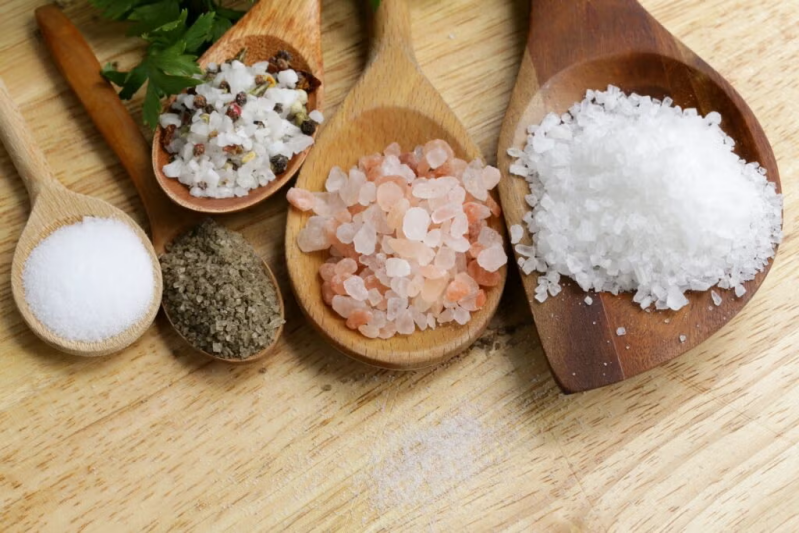
There are four common types of salt: Table Salt, Sea salt, Himalayan Pink Rock Salt, Celtic Grey Sea Salt.
It is important to differentiate between a natural salt and table salt. Table salt is a commercially refined salt; that is not only stripped of all its minerals, besides sodium and chloride, but is also chemically cleaned, bleached and heated at unnecessary high temperatures. In addition, it is treated with an anti-caking agent usually sodium aluminosilicate E554 which prevent salt from mixing with water in the salt container.
Natural salts come in their complete, whole form.
Always choose a natural salt and avoid the processed table salt variety. Throw it away! Or use it in your garden to kill slugs.
What is the best kind of salt?
Regular Natural Sea salts contain a small amount of natural iodine, although not nearly as much as iodized table salt. It is typically much less refined than table salt and comes in both fine and coarse varieties. Sea salts contain many more beneficial minerals and tastes better to most people.
Pink Himalayan rock salt is rich in minerals, containing all 84 essential trace elements required by your body. Pink salt can assist in many bodily functions, such as reducing muscle cramps, promoting blood sugar health and promoting healthy pH in your cells.
Celtic sea salt is an unrefined, unprocessed, and sourced from clean coastal waters along the Guérande Region of Brittany, France. Containing unprocessed and naturally forming minerals, this grey Sea Salt is harvested by traditional Celtic methods using a paludier, by a saunier; a craftsman salt harvester.
What is a good quality salt? Celtic Sea Salt contains a higher mineral content than Himalayan and even contains trace amounts of iodine, naturally.
What is the best kind of salt to cook with?
Generally, most salts will taste the same, unless they contain a large amount of trace minerals. If you do find a strange taste in your salt, try changing brands as there may be contamination.
Benefits of adding natural salt to your diet
With that in mind, here are five benefits of salt in your food.
- Helps you stay hydrated
To stay better hydrated your body needs a delicate balance of sodium and potassium. This is because water in your body follows sodium, so if you have too much your body will retain water. Potassium works to balance this out, which is why sea salt is much better than sodium chloride or table salt i.e. refined salt. Sea salt like Celtic or pink Himalayan contains both sodium and potassium, which helps balance your levels naturally.
- Promotes good vascular health
When it comes to sea salt specifically, it actually has protective effects against heart disease. Again, it’s important to differentiate between sea salt and refined table salt, which is much less beneficial due it’s non-existent mineral profile. The findings on how sea salt helps heart disease markers directly contradict the years of recommendations against salt in diets – it’s just important which type of salt you’re using.
- Balances electrolytes and prevents muscle cramping
Sea salt is an excellent source of electrolytes, which has been shown to prevent muscle cramping during exercise. Sea salt contains sodium, magnesium, potassium, and calcium, all of which you need for optimal health. These minerals must come from your diet because your body can’t create them. Without sufficient electrolytes you can experience irregular heartbeat, fatigue, nausea, and even seizures.
- Supports a healthy nervous system
Sodium regulates water flow throughout your body, which is critical for a healthy nervous system. Additionally, the water of your nervous system requires salt for electrical conduction to send and receive nervous system signals. Just as with other functions of the body, your brain needs the right balance of sodium to other electrolytes, which is why sea salt is a much better option than table salt.
- Improves sleep
When you read about salt and sleep, it initially appears there are mixed reports. But if you pay close attention, you will realize that the advice against eating salt before bed is referring to table salt and processed foods, which can cause an unbalanced amount of sodium in the body. Sea salt is thought to improve sleep because it contains so many helpful electrolytes for regulating hormones.
When you swap your table salt for a natural salt you might find you have better sleep, are less thirsty, hungry, and more satisfied when you eat. It is also important to make sure you get enough salt anytime you exercise because your body is sweating it out. For anyone who participates in high intensity sports or competition, they make salt tablets for better rehydration.
Five fun facts about Himalayan Pink Salt:
- What makes Himalayan salt pink? Magnesium, calcium, potassium and iron are common elements in Himalayan salt. The pink colour may come in part from magnesium, while the red is from iron oxide (yes, good old-fashioned rust), though it is present only in trace quantities.
- Traditional uses of Himalayan pink salt include cooking heating a big block of salt in the fire and cooking right on the block who would do such a crazy thing? It was likely invented by the Pakistanis, Afghanis, and Indians who had early access to blocks of salt.
- There is more than one Himalayan pink salt, tapping deposits that formed at different places and times. The Khewra Salt Mine in the Punjab province is the largest salt mine in Pakistan and produces the majority of the Himalayan Pink Salt sold to export markets. The Warcha mine in Khyber Pakhtunkhwa province produces a salt that is often darker in colour than some other Himalayan salts. Colour varies from white to pink to red to silver-grey and even, occasionally, blue. Purity (absence of rocky debris) varies greatly even within the same mine as great swirling marled formations are exposed within salt seams extending deep into the earth.
- The Khewra Salt Mine in Pakistan produces 385,000 tons of salt per year, supporting the local economy as well providing a source of revenue from exports to other countries. While it is the largest of Pakistan’s mines by far, it delves into only a tiny fraction of a truly massive salt deposit running along much of the 300 km Salt Range mountains from which it is mined. The deposit is as much as 500 metres feet deep in places, and several kilometres in width.
- Himalayan salt is not renewable, but nor it is not exhaustible. It will take millions of years for the salt you consume to re-evaporate into a salt flat, get buried under sediment, be thrust deep into the earth by plate tectonic forces, and compress to the pure pink halite you know and love as Himalayan Pink salt. But fear not, we won’t be running out of it anytime soon. There are an estimated 10.5 billion tons of salt deposits at the Bahadurkhel mine alone. At the current rate of 139,268 tons per year, it will last 75,394 years. And while our progenitures are waiting for more salt deposits to form, all of that mined salt will available along with 50 quintillion (50,000,000,000,000,000,000) kilograms of salt within our planet’s oceans.
The main constituents of sea salt are basically chloride (55.2%), sodium (30.6%), sulphate (7.7%), magnesium (3.7%), calcium (1.2%), potassium (1.1%) and a few others.
SALT GEOMETRY:
Shape and size of salt influences how tightly it packs:
Table salt is small cuboid crystals and packs tightly
Sea salt is larger more random crystals
As a result, a teaspoon of table salt is about 7g but a teaspoon of Maldon for example is approximately 5g but Maldon Crystals approximately 3g per teaspoon.
Salt’s geometry also determines how it functions.
Small crystals dissolve much more quickly than large crystals (duh!)
So, table salt would make a quick brine but would be better to sprinkle your salad with bigger crystals for a crunchy mouth feel and other nutritional and organoleptic qualities.
So briefly if your salt is in large crystals, flavourful and expensive…..it is conceived for finishing your dish!